True or False? Are we experiencing a youth gambling crisis in Britain?


Tomorrow, the Gambling Commission will publish results from its Young People and Gambling Survey 2025. The survey is often portrayed in the news media and in Parliament as indicating a ‘youth gambling epidemic’ or evidence of widespread ‘addiction’. As the Gambling Act 2005 recognises, children are particularly vulnerable to harmful consequences from gambling and this necessitates a range of specific protections in law and regulation. Some stakeholders have used statistics from the Young People and Gambling Survey (‘YPGS’) to support demands for significant strengthening of these measures, including advertising bans. In this article – an updated version of one that originally appeared on the SBC Player Protection Hub in 2024 - I examine the facts behind the figures.
1. True or False - is there is an ‘epidemic’ of underage gambling in Great Britain?
False. Official statistics from the YPGS, reveal that gambling by schoolchildren has declined significantly over the last decade. Past-week rates of participation fell from 23% in 2011 to 6% in 2024. This is despite the recruitment of older age groups to the survey (originally the survey covered 11-15-year-olds; with 16-year-olds were added in 2017 and 17-year-olds in 2023).
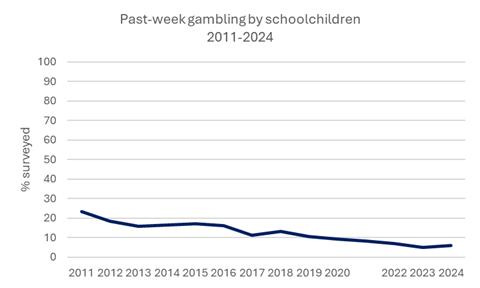
In recent years, the survey has included estimates of past-year (as well as past-week) gambling, and this also indicates a generally downwards trend – from 39% in 2018 to 27% in 2024. The overwhelming majority of this gambling has been legal – playing amusements (for example, penny pushers or crane grab machines) at seaside arcades, family games of cards or private betting between friends. In 2024, 6% of the schoolchildren surveyed claimed to have participated in age-restricted (18 years +) forms gambling. Where this occurred, it appeared in general to be facilitated by parents, guardians and other adults.
Concerns about children and gambling are sometimes expressed in relation to advertising – but matters are often not quite what they appear to be. It is, for example, claimed that gambling adverts ‘normalise’ gambling (a curious term for what is still a legal pastime for adults). Such assertions are typically based on research findings that show children have a level of familiarity with betting and gaming brands (similar findings have been made in relation to drinks brands). On the other hand, research has shown that some children develop negative impressions of gambling as a direct result of advertising (hardly surprising given the nature of many of the commercials produced in the last ten years).
One commonly cited academic paper found that social media adverts had “particular appeal to children and young persons”; but this finding relied on the premise that adulthood commences at the age of 25 years rather than 18. It also found that adverts for insurance services (hardly the most glamorous industry) had a stronger appeal to children than those for betting and gaming.
A study by ScotCen found “a significant association between the reported exposure to advertising of under-18s who were non-gamblers and their intention to gamble; researchers considered this an indicator of their ‘susceptibility’ to gambling.” The researchers, however, had defined as ‘susceptible’ anyone who refused to rule out the slightest possibility that they might participate in gambling in the future. Analysis of the survey results reveals that a large majority (83%) of those deemed ‘susceptible to gambling’ had said that they ‘probably’ would not gamble in the year ahead. Of the entire survey sample of non-gamblers, 93% said that they ‘probably’ or ‘definitely’ would not gamble. This presents a rather different picture to the one painted by activists and some parliamentarians.
The Young People and Gambling Survey found that 7% of the schoolchildren who had reported seeing an advert claimed to have gambled as a result on at least one occasion – but it does not reveal what they gambled on or even whether they had taken part in the activity being advertised. It is instructive to note that 0.6% of the survey sample said that they had been prompted to gamble and that they had gambled online (which does not mean that they had been prompted to gamble online). Given that lotteries top the list in terms of betting and gaming adverts seen by children, it is possible that the National Lottery accounts for a sizeable element of those prompted to gamble. This may still be a cause for concern, but it would indicate a different set of policy responses to those typically suggested.
All of this does not mean that there is no problem where underage gambling (or even legal gambling by minors) is concerned – but the scale of participation is markedly lower than some activists claim, it has been moving downwards and taking place for reasons other than those commonly asserted.
2. True or False - 85,000 children are addicted to gambling?
False. This claim is derived from the Young People and Gambling Survey which, in 2024 found that 1.5% of schoolchildren were classified as ‘problem gamblers’, using criteria set out in the DSM-IV-MR-J instrument.
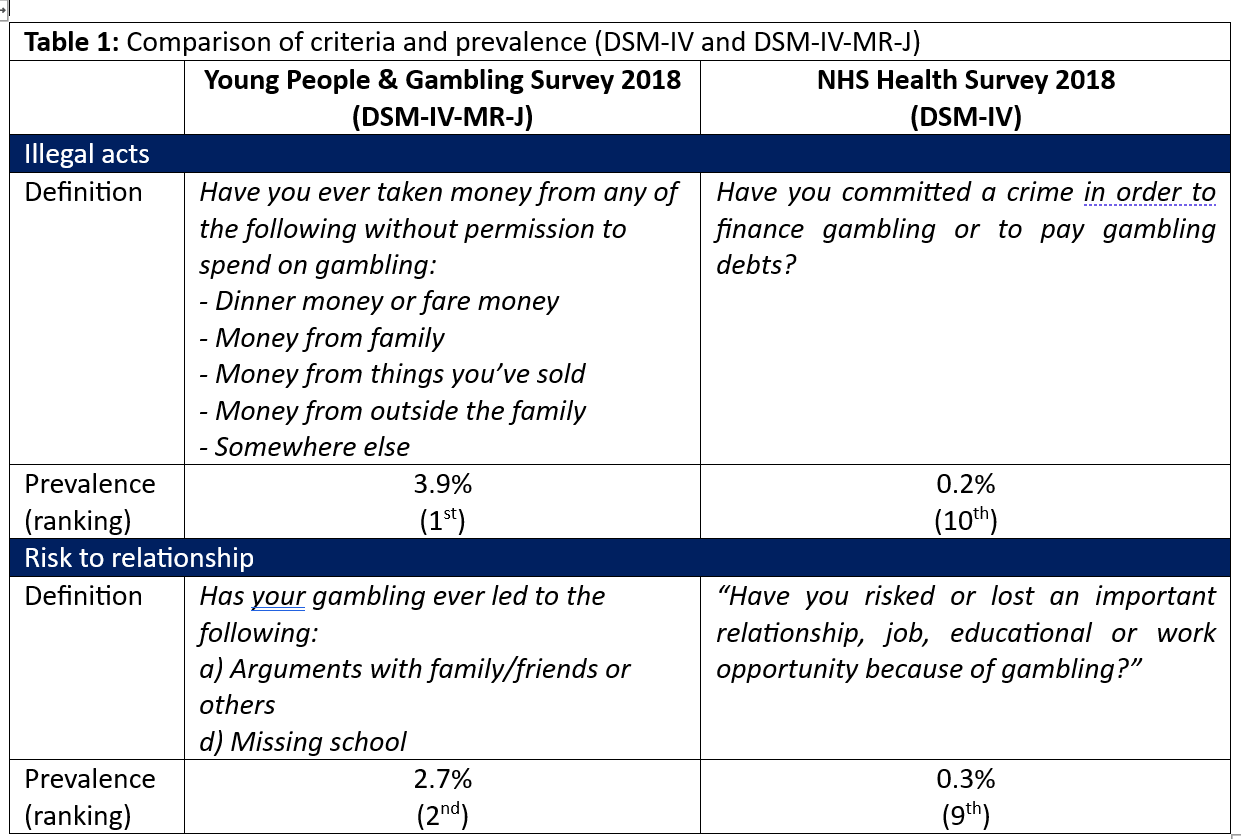
The first observation that should be made here is that the DSM-IV-MR-J does not measure ‘addiction’ (which is simply not within its system of classification and requires a clinical diagnosis). It is used instead to estimate rates of ‘problem gambling’ among the juveniles – but this is different to ‘problem gambling’ measured by screening instruments used with adult populations. The DSM-IV-MR-J generally uses softer definitions and lower thresholds of risky behaviour and harmful outcomes. By way of illustration, the two most commonly endorsed items on the DSM-IV-MR-J – ‘illegal acts’ and ‘risk to relationship’ – are the two least endorsed items on the DSM-IV instrument, used in the NHS Health Survey for England. As table 1 (below) illustrates, the DSM-IV-MR-J effectively defines ‘illegal acts’ as the use of any money to gamble that has not been expressly provided for that purpose (which for the most part will not involve criminality); whereas ‘risk to relationship’ encompasses arguments with family and friends (which tend to be a common feature of childhood).
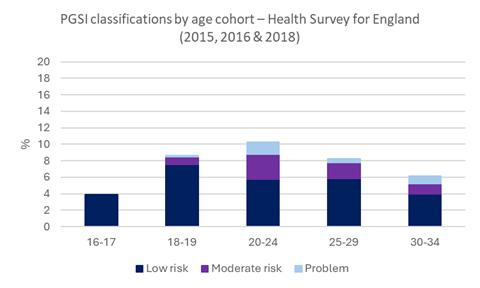
One inconvenient truth for those alleging widespread addiction or problems is that NHS Health Surveys have consistently found very low levels of ‘at risk’ and ‘problem’ gambling for 16 and 17-year-olds (using the PGSI and DSM-IV instruments). In 2015, 2016, 2018 and 2021 (the last four years in which gambling questions have been included), NHS Health Surveys reported nil rates of PGSI ‘problem gambling’ and ‘moderate risk gambling’ for respondents aged 16 and 17. Reported rates of ‘problem gambling’ have also been very low (0.1%) for 18 and 19-year-olds. The suggestion that there is a high level of gambling disorder (i.e. the behavioural addiction) between the ages of 11 and 16 that miraculously disappears between the ages of 16 and 19 warrants curiosity at the very least.
One odd feature of the Gambling Commission’s Young People and Gambling Survey reports is the omission of any information about the activities participated in by ‘problem gamblers’ (as is the protocol with the NHS Health Surveys). Analysis of the YPGS (2018-2020), held by the UK Data Service, reveals that the highest rates of ‘problem gambling’ have been observed among players of lottery games. Around one-third of children classified as ‘problem gamblers’ did not report participating in any age-restricted (18 years +) activities in the prior year.
Online gambling is often cast as the pantomime villain where ‘problem gambling’ by children is concerned; but a lower percentage of underage online gamblers were classified as ‘problem gamblers’ than for players of some National Lottery games. Looked at another way, a majority of the ‘problem gamblers’ in the surveys had not gambled online at all (compared with around three-quarters who had played amusement machines, played cards with family and friends or bet with friends). Once again, this runs counter to what some campaigners, activist-researchers and parliamentarians have implied.
Then there is the question of survey reliability. There is some evidence from the Young People and Gambling Survey that children may in fact overstate their involvement in wagering. The survey asks respondents which types of gambling they have participated in (15 defined activities plus a catch-all, ‘other gambling’). Between 2018 and 2020, of those classified as ‘problem gamblers’, around one-in-five said that they had participated in every single form of gaming and betting contained within the survey, including playing table games in a casino, bingo in a bingo club, betting and machine gaming in a bookmakers, amusements in arcades and pubs, online gambling and every single type of National Lottery and private lottery game. Of these, around two-thirds said that they had done so in the seven days prior to taking the survey. It may come as a surprise to some – but children do not always tell the truth.
3. Conclusion
There are valid concerns about gambling by children – but as with all serious matters, the misuse of statistics is unlikely to result in effective responses. The uncritical repetition in Parliament of misleading claims reflects poorly on the role of some of its members as scrutineers. The Gambling Commission should be the guardian of Official Statistics on underage betting and gaming (as the commissioner of the Young People and Gambling Survey) but is generally reluctant when it comes to addressing misinformation. There is more that can and should be done by the industry and other parties to reduce the rate of underage gambling (including where it is facilitated by grown-ups) and to prevent children being attracted to betting or gaming in the first place. For such work to be effective however, requires an accurate assessment of the situation rather than propaganda; and a grown-up and collaborative approach from a range of stakeholders.