Curiouser and curiouser
Lord Foster disappears down a rabbit hole of his own invention

Last week Lord Foster of Bath took us once again through the looking glass of gambling policy discourse. Just as the Queen of Hearts professed to believe six impossible things before breakfast, Foster seems to dream up any number of fantastical claims before his Horlicks’ has brewed. In the space of just 30 seconds last Thursday, the Liberal Democrat peer told the House of Lords five things that are untrue about children and gambling.
Perhaps the silliest of the noble Lord’s claims was that there are 80,000 children in Britain addicted to gambling. This, as the Gambling Commission and others have pointed out in the past, is a corruption of findings from the 2023 edition of its Young People and Gambling Survey (‘YPGS’) and constitutes a misuse of official statistics. It is based on the self-reported behaviours of 25 schoolchildren, many of whom reported no harms from gambling but were classified as ‘problem gamblers’ on the basis of risky behaviours. The most commonly reported activities engaged in by these children were entirely legal, including seaside amusements and wagering or playing cards with family and friends. Several of the children involved reported no participation in age-restricted forms of gambling. According to Lord Foster’s interpretation of the YPGS, there are as many as 54,400 children in Britain addicted to seaside amusements (or 44,800 addicted to playing cards within the family or betting with schoolfriends).
It is easy to see how the casual reader might misinterpret the YPGS statistics – but this is not an excuse that Lord Foster can easily claim. As a Member of Parliament, he fulfilled the role of Liberal Democrat spokesperson on gambling. Between 2019 and 2020, he sat on Lord Grade’s House of Lords Select Committee on Gambling; he is currently chair of the pressure group, Peers for Gambling Reform; and a member of the activist organisation, Action on Gambling. In short, Lord Foster considers himself a subject matter expert. He recently served on the House of Lords Liaison Committee on Gambling where he received evidence from the Gambling Commission and others regarding the meaning and reliability of data from the YPGS – evidence that he appears to have disregarded. The possibility must therefore be considered that Lord Foster knew that what he told his fellow peers was not strictly accurate.
As I described in a recent article in the Racing Post, some consider it acceptable to disseminate misinformation on gambling harms in support of what they perceive to be a just cause (the suppression of licensed betting). This is a version of Plato’s ‘noble lie’ – the idea that it is permissible for the state to mislead the populace in what it considers to be their best interests. There are, of course, instances where a lie might be considered justified (during times of war or national emergency), but this is neither liberal nor democratic and not something to be encouraged. It should be no more acceptable to manufacture statistics on harmful gambling as it would be for heart disease. Misinformation is a lousy basis for sound policy.
The interminable debate on the regulation of gambling is crying out for those in positions of authority to set the example and demonstrate moral leadership. Almost three years ago, the then chief executive of the Gambling Commission, Andrew Rhodes, published an open letter on the unacceptability of statistical misuse, threatening robust action. After a brief flurry, this war on misinformation petered out, with the regulator explicitly watering down its guidance in order to avoid the need to act. The Commission occasionally requests corrections where official statistics are misused but these are invariably ignored. Mr Rhodes’s threat of referral to the Office for Statistics Regulation for repeat offenders has been exposed as a paper tiger.
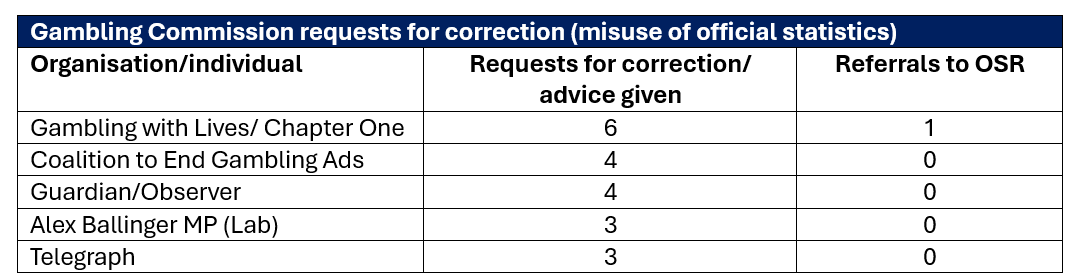
Among serial abusers of statistics, a novel line of argumentation has emerged – the proposition that factual accuracy is beside the point because the evidence base as a whole indicates the need for ever more draconian state intervention. Quite aside from the fact that good research tends to be messy (and rarely points in a single direction), this ignores the fact that the evidence base itself is constituted of a wide array of facts and figures. Once the principle is accepted that reliability is no longer a prerequisite for individual data points, the validity of the so-called ‘evidence base’ as a whole must be called into question.
The Gambling Commission has fatally undermined its ability to hold others to account by itself publishing misleading statistics, misrepresenting research findings, suppressing evidence on the basis of convenience, funding numerous research projects of questionable quality and even paying campaigners to lobby for regulatory reform. Over the course of the last seven years, The Commission has squandered the reputation for trust and competence built so carefully by its first two CEOs, Jenny Williams and Sarah Harrison. A growing number of commentators, including Vaughan Lewis, have questioned whether it can any longer be considered fit and proper.
The great tragedy of the current situation is that – at a point where funding has never been greater for the study of gambling behaviours and gambling harms – the quality of research has never been poorer. The establishment of a new £10m a year national centre for the study of gambling harms should create the foundations for scientific progress. The decision to locate this centre at the University of Glasgow – a hotbed for anti-gambling activism – means that these hopes are unlikely to be fulfilled.
The indifference to factual accuracy of the regulator, parliamentarians and academic researchers bodes ill. The industry has been far too tolerant of misinformation – perhaps because it is a game that it has played itself at times. Unless that changes, the very laws that govern the operation of the licensed market are at risk of subversion. For now, the noble Lord Foster and several others in Parliament might accept a little wisdom from the March Hare: “Ah, but that’s the point! If you don’t think, you shouldn’t talk!”